It is one of the classic dishes of the Languedoc and the whole of France. One legend places the birth of cassoulet during the siege of Castelnaudary by the Black Prince, Edward, Prince of Wales, in 1355. The townspeople gathered their remaining food to create a big stew cooked in a cauldron to nourish and bolster their defenders. The meal was so hearty and fortifying that the soldiers handily fought off the invaders, saving the city from occupation. While this is probably not the actual way it went down regrading the origin of cassoulet, one never knows and what is certain, is the importance of the dish as the symbolic defender of French culture.
But since then, several cities have laid claim to the true recipe. In an effort to quell a growing dispute and in a conciliatory gesture, chef Prosper Montagné decreed in 1929, " Le Cassoulet est le dieu de la cuisine occitane. Un Dieu en trois personnes: Dieu le père est celui de Castelnaudary, Dieu le fils est celui de Carcassonne et le Saint-Esprit qui est celui de Toulouse." ("God the father is the cassoulet of Castelnaudary, God the Son that of Carcassonne, and the Holy Spirit that of Toulouse."), making sure all three recipe versions were recognized as equal.Now that's village pride. Over a bean stew.
Andre Daguin, a famous chef of Gascony says, “Cassoulet is not really a recipe, it’s a way to argue among neighboring villages.” Much like chili cook-offs in Texas, cassoulet cooking competitions are held, not only in France, but now even in the United States as well.
Julia Child once quipped, “Cassoulet, that best of bean feasts, is everyday fare for a peasant but ambrosia for a gastronome, though its ideal consumer is a 300-pound blocking back who has been splitting firewood nonstop for the last twelve hours on a subzero day in Manitoba.” And finally, Anatole France claimed that the cassoulet at his favorite restaurant had been bubbling away for twenty years!
While this recipe won't take quite as long as Anatole's, this does require a good amount of time if you truly want to do it right. This is a hearty and great alternative to plain old stew and can be a great way to use up all those leftovers by simply adding some fresh ingredients and some extra TLC in the kitchen. And duck. To me, really great cassoulet has to have duck, but everyone's palate is different. Some really rustic and kicked up versions include rabbit and they are some of the best I have ever tasted as well. This dish requires a little more attention than most , but the outcome is well worth it. Especially if you have the duck.....
Elaine's Rustic Cassoulet courtesy of Elaine Giammetta
Ingredients
1/2 lb bacon, cubed
1-15 oz can white kidney beans
1-15 oz can pinto beans
1 large Spanish onion, diced
10 garlic cloves, minced
3/4 lb ground pork
1/4 lb shredded duck confit
1 T dried parsley 2 T dried thyme leaf
1 T rosemary
1 bay leaf
1 t rubbed sage
1/4 to 1/2 c sherry (I use dry)
2-3 qts water (enough to cover all ingredients )
salt and pepper
fresh parsley
Method
In a slow cooker, or large heavy bottomed pot, spread the bacon cubes, evenly over the bottom of the pan. This will be the first layer. Drain and rinse the beans.
Mix beans, onion and garlic together and spread over the bacon creating the second layer. Crumble the ground pork and duck over the beans. This is the third layer.
Mix all the herbs together (except the bay leaf) and sprinkle over the meat. Add water and sherry making sure all the ingredients are covered. This is important, so to ensure proper cooking.
Add the bay leaf. Set temperature on very low and cook 6-8 hours or overnight if possible. If you are using a traditional pot, bring to a boil and then lower temperature and simmer on very low for 6-8 hours. After cooking is complete, gently stir in chopped parsley. Salt and pepper to taste.
Plating
Ladle into a bowl and top with a sprig of parsley. Serve with a warm baguette and a hearty glass of red wine. I chose a nice peppery Malbec. I hope you enjoy it.
Roasting a turkey during the Holidays can either make or break a successful meal. Like many at home cooks, I have a few horror stories of the days before I became the self proclaimed, "Gourmet Guy." I have also heard stories from others, both friends and family, about such things as leaving the plastic 'chitlins' bag' in the bird, raw and underdone turkeys, to piles of charcoal on a plate. In this installment, I am going to give you some fool proof rules-of-thumb and methods to insure that your Thanksgiving meal comes off as a complete success that will wow your guests. From the Menu Planning, to Proper Seasoning , to how to pick the right turkey, we'll take a look at all the basics.
How big of a turkey should I roast?
Most importantly, we need to count the amount of guests we will be serving. A good rule of thumb to go by would be:
One (1) pound of raw turkey per person which includes a moderate amount for leftovers.
1 1/2 pounds per person, if you have hearty eaters or want ample leftovers.
3/4 pound of whole turkey per person for no leftovers.
To properly thaw the turkey (if frozen), I recommend leaving it in a refrigerator for 4-5 days to slow thaw under a cool temperature. If you are pressed for time, you may place it in a sink or a container in the sink and run cold water over it for a few hours. Once the bird is thawed, you are ready to prepare it for cooking.
Brining (optional)
Not every home cook will go the extra mile at home, but I’ve found that brining your turkey can incorporate a great level of flavor and make your turkey extremely moist. I typically brine most poultry and pork before cooking, and have made several different types of flavored brines. A brine by definition is; a strong solution of water and salt used for pickling or preserving foods. A sweetener such as sugar or molasses is sometimes added. I really enjoy molasses and brown sugar and balance it out with some savory herbs, bay leaves, peppercorns and garlic. Depending on the size of the bird, you can brine a turkey for a few hours, or even let it go overnight. But, it is very important to remember that the brining solution is high in salt and you must adjust and lessen the amount of salt you use in your seasoning when you prepare your turkey for roasting.
Seasoning & Prepping the Bird
The next step can be a lot of fun, as you get to be very creative with seasoning and preparing your turkey. Seasonings offer a great deal of flavor and can be as simple as salt and black pepper, or as elaborate as Cajun spice or a rub consisting of garlic, chilies and dried herbs. Be sure to rub the entire cavity with your seasoning blend of choice, and always lubricate the outside of the skin with oil or butter so the seasonings will adhere and cook into the bird.
*Tip For Crispier Skin Crisp skin and a moist center is what we all desire when roasting the perfect turkey and I have learned a little trick to enhance the outer skin. Carefully lift the skin up around the bird and slide a few pats of softened butter underneath. Generously rub the outer skin with butter and your seasonings, and let them sink in for about an hour before roasting. Many family recipes include stuffing the bird with all kinds of aromatics or even a traditional bread stuffing. It is totally up to you to decide which way you want to go, but stuffing a turkey's cavity can really enhance the flavor of the meat.
Stuffing
There are two schools of thought when it comes to stuffing; In the Bird (stuffing) and & Out of the Bird (dressing). In my house we make both, or sometimes do a cornbread Oyster dressing (recipe below) as well. In some households, the turkey is stuffed with other birds; a boned chicken is stuffed into a boned duck, which is then stuffed into the turkey. Called a Tur-duck-en, this is actually not a new concept. In ancient Rome, as well as in medieval times, cooks stuffed animals with other animals.
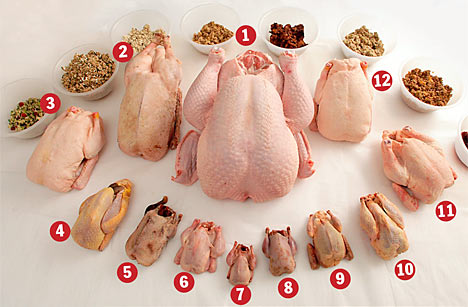
Ten Bird Roast, but there's 12?
A 13th century Andalusian cookbook includes a recipe for a ram stuffed with small birds. A similar recipe for a camel stuffed with sheep stuffed with bustards stuffed with carp stuffed with eggs is also mentioned in T.C. Boyle's book Water Music. British celebrity chef Hugh Fearnley-Whittingstall makes an incredible ten-bird roast, calling it "one of the most
spectacular and delicious roasts you can lay before your loved ones." A large turkey is stuffed with a goose, duck, mallard, guinea fowl, chicken, pheasant, partridge, pigeon and woodcock. The roast feeds around 30 people and also includes stuffing made from two pounds of sausage meat and half a pound of streaky bacon along with sage, port and red wine. Wow, now that truly is a mouthful!
Turkey stuffing usually consists of bread crumbs or cubes, dried bread, with onion, celery, salt, pepper, and other spices and herbs such as sage, or a mixture like poultry seasoning.
In some cases, sausage or oysters are added as well. The term stuffing usually applies to the mixture when it is placed
into the bird, while dressing is usually used when cooked outside. If you want to add a little sweetness to the turkey, stuff the cavity with some apples and raisins. If you are looking for something more savory and herbaceous, try adding rosemary and thyme with a little garlic and onion. For our purposes here, and since I am the Gourmet Guy, we'll just stick to a traditional Oyster Stuffing.
Recipe Makes 14 cups Ingredients
1 3/4 cups chicken stock
1/4 cup salted butter
5 cups crumbled cornbread
1 pound bulk pork sausage, rendered and drained of fat (optional)
Turkey giblets, cooked and chopped (optional)
1 1/2 cups chopped onion
3 stalks celery, diced (if you do not like cooked celery, as I do not, you can substitute a teaspoon of celery salt, but adjust your salt amount accordingly) 2 eggs
1 pint shucked oysters, drained, or more if desired (reserve the oyster liquor, should be about a 1/4 of a cup)
1 teaspoon poultry seasoning
1/4 cup chopped fresh parsley
1 teaspoon salt
1 teaspoon dried sage
1 teaspoon paprika
Ground black pepper to taste
Method In a skillet, saute the celery & onions in butter until translucent. Remove. In the same pan, saute the sausage until just about done, but don't overcook. Drain.
In a large
bowl combine the crumbled cornbread, cooked celery, cooked onions,
cooked giblets, cooked sausage, oysters, parsley, salt, pepper, paprika, dried sage. Mix well. Beat the 2
eggs. Add the eggs and chicken stock and oyster liquor to the stuffing mixture and thoroughly incorporate. In the bird: Stuff the bird's cavity. Remove stuffing promptly once bird is cooked. Out of the bird: Bake the stuffing in a large
casserole dish in a preheated 350 degrees F (175 degrees C)
oven approximately 1 hour and 20 minutes. Roasting Your Turkey
So, now that we are ready to roast, how do I know how long it should cook for, and how high the temperature should be? USDA says that a turkey should not roast under 325 degrees Fahrenheit, so that’s a fair starting point. Approximate cooking times for an unstuffed turkey are as follows: (it is around 20 to 30 minutes per pound)
10 - 18 lb bird 3 to 3 ½ hrs
19 – 22 lb bird 3 ½ to 4 hrs
22 – 24 lb bird 4 to 4 ½ hrs
24 – 29 lb bird 4 ½ to 5 hrs
One helpful hint to achieving a nice golden skin, is to start the "searing" process by cooking it in a 400 - 425 degree oven for 10-15 minutes (depending on the size) to start the browning process (sugars begin to caramelize), then lower the temperature to 325 degrees and slow roast for the appropriate time. Basting is another way to impart even browning and to distribute some of those great flavorful juices. You may baste with the juices found in the bottom of the pan, or use some type of fat. Also popular, is to baste with another flavorful liquid, for example a brown stock fortified with apple cider vinegar and herbs. If the bird begins to brown too much, you may cover it with aluminum foil until it has reached doneness, and then finish for the last few minutes uncovered. Be careful not to cover the bird entirely, as you don’t want to steam the turkey.
How do I know if my bird is done? The USDA recommends that the turkey be cooked to a temperature of 165 degrees as measured in the innermost part of the thigh. If the thigh is 165 degrees, the breast meat is likely to be 10 degrees hotter. Many cooks would tell you that a turkey roasted to those temperatures is overdone and would taste unacceptably dry. Use a meat thermometer to check for doneness, try not to rely on those "pop up timers" that come with most turkeys. You can also prick the leg joint with a fork, and if the juices run just slightly pink or clear, the turkey is done.
To test the accuracy of your instant read thermometer, insert the tip about 2 inches deep into boiling water. At sea level it should register 212 degrees F. If it does not, replace it; or if it has a calibration device, reset it for accuracy. Nobody wants an overcooked bird, so start checking your bird about 3/4's of the way through the total recommended cooking time.
Gravy Time to make the gravy! On the stove top, use the same pan that you roasted this delicious turkey in. The drippings and leftover fat and liquid are going to make this gravy a very tasty one. I like to use a ratio of 1 Tablespoon of fat to 1 Tablespoon of flour to create a "roux" that will thicken my gravy. You can use chicken or turkey stock, or even just deglaze with sherry or white wine and add water. Just be sure to cook out the flour so it doesn’t leave a raw taste to the gravy. Season with salt pepper to taste.
Lou's Traditional Cranberry Sauce
Ingredients
12 oz Cranberries, Fresh Frozen
1 3/4 Cups Water
1 Cup Granulated Sugar
1 Cup Light Brown Sugar
2 Cup Orange Juice
1 Tbl Orange Zest, Chopped
1 tsp Ground Ginger
1/2 Cinnamon Stick
Method:
Place all ingredients in a sauce-pot, except the cranberries and bring to a boil. As soon as it boils, add the cranberries to the liquid. reduce heat to medium. Cook for approximately 5 minutes until all of the cranberries have "popped". Remove the cinnamon stick, and cool. The liquid will be loose and will thicken once it cools.
Turkey is done, gravy is ready and now it's time to roll out all the
fix-ins. Cranberry sauce, sweet potato pie, cornbread stuffing, yams,
green beans, creamed onions, apple and pecan pie are just some
of my favorites! Try something new this year and let me know how it
comes out! We all have a lot to be thankful for and I am very blessed
with such wonderful family and friends. God
Bless and Happy Thanksgiving. Don’t forget to save me some leftovers!
If you have grown up in a Jewish or Scandinavian household, the tale I am about to tell is a part of your heritage. If not, fellow foodie, "just sit right back and you'll hear a tale..the tale of a fateful........salmon fillet!" Come with me on a journey to discover Lox, and, the common misconceptions that have been foisted on an unsuspecting public, even by supposed culinary luminaries. That, my friends, is why it's a good thing I am here for you; to diligently give you culinary info that is both factual and entertaining. (if I may say so myself.)
First let's start with the definitions. We have Lox, Gravlox, Nova Lox. All share one commonality but, as some of you may not be be aware, they are completely separate and different products.
Lox
Lox is salmon fillet that has been cured. In its most popular form, the one most of us are familiar with, it is thinly sliced, less than 5 millimeters (0.20 in) in thickness and typically served on a bagel with cream cheese, onion, tomato, cucumber and capers. It is traditionally made by brining in a solution of water or oil, salt, sugars and spices (the brine). This was a very important item in Ashkenazic Jewish cuisine, but most are surprised that it was actually introduced to the United States through Scandinavian immigrants, then popularized by Jewish immigrants. The term lox derives from Lachs in German and לאקס (laks) in Yiddish, meaning "salmon." It is analogous of the Icelandic and Swedish lax, the Danish and Norwegian laks, and Old English læx. It may be commonly referred to as regular lox or belly lox, though technically, with belly lox, the flesh on both sides of the stomach of the salmon has a wider graining of fat, is less salty tasting and is more desirable and accordingly, more expensive. Below is a recipe to make your own Lox, which is absolutely fabulous and worth the effort, especially if you are a lox lover.
Gravlax Gavlax, or gravad lax is a Nordic dish consisting of salmon, cured in salt, sugar, and dill. Gravlax is usually served as an appetizer, sliced thinly and accompanied by hovmästarsås (also known as gravlaxsås), a dill and mustard sauce. It is served on either bread of some kind, or with boiled potatoes. In the Middle Ages, it was originally made by fishermen. They would salt the salmon, then bury it in the sand above the high-tide line. The word gravlax comes from the Scandinavian word grav, which literally means "grave" or "to dig" (Swedish, Norwegian, Danish, Dutch and Estonian), and lax (or laks), means "salmon." Thus, gravlax literally means "buried salmon." Today, the salmon is coated with a spice mixture, which often includes dill, sugars, salt, and spices like juniper berry. It is then weighted down, which helps to to force the moisture from the fish (see recipe below) and impart the flavorings.
Nova Lox Nova or Nova Scotia salmon, sometimes called Nova lox (or simply "Nova"), is cured with a milder brine and then cold-smoked. The name dates from a time when much of the salmon in New York City came from Nova Scotia. Today, however, the name refers to the more mildly brined product, and the fish may come from other waters or in some cases is raised on farms.
Smoked Salmon
Finally, smoked salmon is NOT lox, though products are sold under the name lox. Smoked salmon is just... well... smoked salmon.
I hope this clears up any misconceptions.While I may be being a bit, nitpicky (if there is such a word), you all know I like my readers to be the best informed foodie at the party, or in this case, brunch. Never let it be said that The Gourmet Guy left you with a schmear on your face.
Recipe for making your own Lox
Ingredients
1~2.5 to 3lb. salmon fillet (I prefer to use a skinless fillet, but if you prefer a less salty version, leave the skin on and remove after brining.)
1 cup Kosher salt
1/2 cup granulated sugar
The juice and zest of 1 lemon
The juice and zest of 1 lime
You'll need:
A 15" x 10" x .3/4" cookie sheet. Enough parchment paper to fully wrap the salmon. Tin foil. Something to weigh down the fillet. I use 3 large, 35.0z. cans of tomatoes. You can use bricks wrapped in foil or anything heavy enough to press down the fillet.
Method
~Combine salt and sugar and divide in half.
~Zest lemon, zest lime and combine with the juice from both. Set aside.
~On the parchment paper, spread out 1/2 the sugar/salt mixture and spread evenly to allow salmon to rest completely on mixture.
~Place salmon on salt/sugar mixture and completely cover with the lemon/lime mixture.
~Add the remaining salt/sugar mixture and press into salmon, covering completely.
~Wrap the salmon in the parchment paper, making sure it is sealed and covers the salmon completely.
~Wrap the entire fillet with tin foil, being careful that the foil at no time touches any part of the salmon.
~Place on the cookie sheet, place weights on top and refrigerate for 48 hours.
~Once you remove the salmon, wash under cold water thoroughly to remove brine mixture. Portion in 6-8 oz. portions, seal in freezer bag and use as needed Slice very thin and enjoy!!
Today's thought is to all the hiring managers, human resource folks, recruiters and those looking to add quality team members to their current adventure.
Many firms, you know who you are, have been searching to fill positions for months and months, looking for the perfect storm, that perfect person that meets all the criteria set forth in the job requirements. The fact that these jobs remain unfilled may not be a sign that that person hasn't applied yet, or that you just haven't found that one individual who will enter in walking on water, espousing every nuance, skill set, trait and background you set forth in your requirements. If you have been searching for over 4-6 months to fill a position, chances are the right person presented themselves to you, and you missed them. Now don't take offense and miss the rest of the message. Your job is not to be right, it's to be correct. We all have two ears and one mouth by design; to listen twice as much as we talk. If your task list doesn't end with the question, "What did I miss?" it's time to add that little gem at the end of each project, to do list or requirement list.
If you have been searching for months, have you asked 'yourself,' "Why haven't I found the 'messiah' of my job search?" It may be because requirements an expectations you have set for your company in its search for new people to add to the team are unrealistic and actually caused you to miss the 'diamond in the rough' because you were expecting a square peg to fit your pre-conceived square hole and when the right person for the job walked in, since they were round, you never saw them, heard their message, or realized the positive impact they could have on your organization. It may also be that your companies hiring practices and procedure are outdated and need to be reviewed and updated to today's ever changing environment.
A perfect example is Steve Jobs; he and Apple changed the world, but his company, putting rules, corporate procedure ahead of performance and results, tried to get it done without him, almost preventing him and themselves the chance to do that because 'he didn't fit the pre-conceived mold.'
He is quoted as saying, "Here’s to the crazy ones. The misfits. The rebels. The trouble-makers. The round pegs in the square holes. The ones who see things differently…they change things. They push the human race forward. And while some may see them as the crazy ones, we see genius."
There are many who have much to offer, but no opportunity to offer it. Were we to pay a bit more attention, looking out instead of in, we'd see many who have great things and talents to offer, but simply lack the opportunity to present their skills and gifts to the world and make an impact. The greatest thing you can do is to give someone the opportunity to shine. Never judge a book by its cover, never conclude without the facts, and never be certain in your judgment and assessment of what someone can accomplish or offer until you take the time, understanding and opportunity to allow them to contribute.
In order to find the diamond in the rough, one must take the time to examine, search, brush away the dust of their own, preconceived notions of what will work and what won't and be willing to be wrong in their assumptions and see the brilliant gem beneath.
I have found throughout the years that when I gave folks an opportunity to shine, hiring someone of character, heart, desire and passion, even if they were 'not as qualified' in skill set, I gained an employee who far outperformed those with the skill set, but not the heart, passion or character.
Skills and procedures can be taught. Heart, passion and character cannot, so change the way you think when looking to hire someone, or add someone to your team. And remember, you are not hiring 'a degree' you are hiring a person. A human, with all the greatness, or foibles, that come with being human. No piece of paper, be it degree or resume, will give you insight into that aspect of your prospect or applicant. Theory and classroom acumen never translate to the real world experience, and expertise, character and work ethic cannot be taught.
Additionally, one of the most important factors in understanding who it is you are interviewing or considering is, "Why they are available in the first place?" It, in my opinion is the most missed question and factors in determining who the person is. Common sense would tell you, unless you are interviewing someone who is currently employed, looking for career change, or they having been downsized due to company or corporate re-structuring, there is a reason that person in front of you is not employed. Regardless of degree or skill set.
Lastly, the best employees and performers I have ever trained and hired were those that came with depth of character and right mindset, willing to learn the job, the company, or skills and expertise I needed in them, rather than those who came with all the knowledge of the job, but lacked the knowledge of how to be the best they could be. The hardest thing to do, and the most unproductive to your company's goals, is to have your managers, team or dept. heads have to un-train all the bad habits one may bring to the position and then try to retrain them in he correct mindset and procedures in order to have them accomplish the duties of the position for which they were hired.
If we change the way we look at things, the things we look at change.



 2 T dried thyme leaf