Introduction to the Collection
During the middle years of the twentieth century two important but very different collections of ancient religious texts were unearthed in Palestine and Egypt: the Dead Sea Scrolls and the Nag Hammadi Library. Visitors to the Gnostic Society Library often do not understand the distinction between these two discoveries. Since our Library collection contains a vast amount of material related specifically to the Nag Hammadi texts (including complete translations), a brief description of the two discoveries might be useful.
What are popularly called The Dead Sea Scrolls consist of a very large number of scrolls – most poorly preserved and many surviving only as tiny scraps – discovered in a series of eleven caves near Qumran and the Dead Sea beginning around 1947. Over 800 separate texts of several divergent types are now recognized among this find. The scrolls date from the "intertestamental period" – a period ranging from about 250 BCE to 100 CE, the epoch after textual formation of the "Old Testament" but still before the formation of Christianity and rabbinical Judaism.
In contrast, The Nag Hammadi Library was discovered in upper Egypt in 1945 and is comprised of 13 ancient leather- bound books (or codices) containing in total 55 texts. The codices were all hidden together, probably around 390 CE, within a large, sealed jar. After 1,500 years buried in the Egyptian desert, they were unearthed in remarkably good condition. The texts in the Nag Hammadi Library date from the first two or three centuries of the Christian era and primarily represent previously lost or unknown Christian sacred writings – writings often described as "Gnostic" in character. Notably included among the texts was an edition of the Gospel of Thomas, a text perhaps older than the four known canonical gospels. While the Dead Sea Scrolls received wide publicity in the first decades after their discovery, the Nag Hammadi Library has only more recently attracted public notice. (For further information about the Nag Hammadi texts, see the Nag Hammadi Library section in the Gnostic Society Library.)
There is now an abundance of information available both in print and on the internet about the Dead Sea Scrolls. This site offers a brief introduction and guide to these resources. We start, below, with a short essay on the Dead Sea Scrolls discovery and associated controversies, intended to help orient readers new to the subject. This is augmented by a descriptive catalog of the best currently available Dead Sea Scrolls Internet Resources. Comprehensive collections of the Dead Sea Scrolls texts in translation are only available in print editions (listed in the bookstore), but a large introductory sample of selected texts from the Dead Sea Scrolls is available here online (several new selection have recently been placed in this collection, available here since 1994). The Gnostic Society Library Bookstore also has a special Dead Sea Scrolls Section with reviews and suggestions on different print editions of the Dead Sea Scrolls in translation, as well as a collection of other important books on the subject.
The Story of the Dead Sea Scrolls
The story of the Dead Sea Scrolls begins in 1947, when – so the tale goes – a Bedouin shepherd found a collection of apparently ancient scrolls in a cave above Khirbet Qumran, near the north end of the Dead Sea. Over the course of the next year, seven scrolls from the cave reached scholarly hands. When examined by experts, the importance and antiquity of the find was quickly understood. For starters, included among these first seven scrolls was a fairly well-preserved copy of the biblical book of Isaiah, soon determined to be the oldest complete manuscript of a Hebrew scripture yet discovered and dating to before 100 BCE.
Another of the seven scrolls was of a more curious nature. Now named by researchers the “Community Rule” (it was first translated and published under the title "Manual of Discipline"), this large and fairly compete manuscript represented a type of Jewish religious writing previously unknown. It appeared to be a document related to the conduct and beliefs held within a sectarian Jewish community sometime between 150 BCE. and 70 CE. – a community seemingly very much like the Essenes described in antiquity by the Jewish historian Josephus.
In 1949 a team lead by Roland de Vaux (an academic and Dominican priest who would dominate Dead Sea Scroll studies for the next two decades) surveyed the cave at Qumran where the scrolls had been found, discovering pottery shards and several more manuscript fragments. Two years later de Vaux directed archeological excavation of the Khirbet Qumran ruins located just below the cave.
 Between 1952 and 1956 ten additional caves containing scroll fragments were discovered near Qumran, almost all located by Bedouins who made a business of scouring through the area. The most impressive cache – discovered again by Bedouins working on at Qumran after de Vaux's 1952 expedition – was located in a man-made cave less than 200 yards from Khirbet Qumran. Named "Cave 4" (in order of its discovery), it contained about 15,000 scroll fragments, identified eventually as the remains of 574 separate manuscripts.
Early in this period of discovery an hypothesis about the source and authors of the scrolls had formed in the minds of de Vaux and his associates. In retrospect, it was only a working hypothesis. But it became a story fixed in history. Faced with several pieces of a puzzle – ancient Hebrew scrolls stored in a cave, a manuscript among those scrolls tentatively identified as the rule of an Essene community, and the ruins of an ancient community's dwelling directly below the cave – de Vaux fit the puzzle’s pieces into a temptingly obvious picture: The Dead Sea Scrolls were the library of an Essene community that once occupied the ruins at Khirbet Qumran. Details disclosed from early excavations at Khirbet Qumran all worked neatly into the story: the ruins contained a large room that would have been a scriptorium (a term previously used to describe rooms in medieval monasteries); remnants of long tables were found that could have served for copying lengthy scrolls; and three ink wells were found.
The "Qumran Hypothesis" – attributing the origins and authorship of the scrolls to an Essene community at Khirbet Qumran, a theory perhaps more accurately called the "Qumran-Essene dogma" – became a party line in Dead Sea Scrolls studies for the next 40 years. The integrity of this thesis was buttressed by highly restricted access to the scrolls. Manuscripts were parceled out for study and translation to a small clique of academics, directed by de Vaux.
In 1955, literary critic Edmund Wilson published an influential series of articles in The New Yorker magazine (later release in book form) which help cement in popular imagination this accepted story of the Dead Sea Scrolls and their creators, the Essenes who dwelt at Khirbet Qumran. Indeed, Wilson took the tale a tantalizing step further, fleshing out the possibility (broached in 1950 by the French academic André Dupont-Sommer) that the first Christians may have borrowed ideas from the people of the Scrolls. Similar to the first Christians, Wilson explained, the Essenes at Qumran had honored an anointed Teacher of Righteousness, performed ritual washings or "baptisms", and shared a sacred meal. Popular interest in the Scrolls has continued ever since to be stimulated by conjectured links between the Qumran scrolls and early Christianity.
Reconsidering the Essene-Qumran Hypothesis
In the last two decades of the twentieth century, several objections to the Qumran-Essene thesis of the Scrolls' origins were voiced within the academic community. Even louder objections arose over continued refusal of the Dead Sea Scrolls "team" to allow all qualified scholars open access to unpublished materials in the collection. After forty years, Scrolls research remained the exclusive domain of a small, self-selected team of scholars. Worse still, over several decades the group had made woefully little progress publishing material from the collection, particularly the large cache of scroll fragments discovered in Cave 4. The whole project was becoming an academic scandal, intermittently punctuated by conspiracy theories suggesting occult purposes motivating sequestration of the yet unpublished materials.
Whatever its various motives, the monopoly on access to the Dead Sea Scrolls collection came to an end in 1991 when the Huntington Library announced it would make available without restriction a complete microfilm copy of the Scrolls in its archives. Soon after, Emanuel Tov, director of the Scrolls project, announced open access and right of publication would be granted to all material in the official collection.
During the last decade, the pace of DSS publication has picked up considerably. So, too, has disagreement about the Scrolls' origins and authorship. Dr. Norman Golb (Professor of Jewish History and Civilization, University of Chicago) has been among the most vociferous opponents to the classic story of the Scrolls' origins. Many of his objections, summarized in his 1995 book, Who Wrote the Dead Sea Scrolls?, seem to be receiving some wider accord.
The "Qumran-Essene dogma" was originally developed to explain a relatively small number of newly discovered documents, including texts in a previously unknown literary style that apparently represented a divergent, "sectarian" voice within Judaism. Early studies of the DSS identified this voice as Essene, and viewed the Scrolls as a remnant of the sect's library. As the numbers and kinds of scrolls discovered multiplied however, critics argued that the probability all these manuscripts had been collected, copied, and archived by a single Essene community living at Qumran dwindled. Over 800 distinct documents have been identified among the scroll fragments found in the caves of the Judean desert. A large number of these are previously unknown works written in several styles. Hundreds of different scribal hands are found in the manuscripts, including fragments in Greek script. In addition, as Dr. Golb argues, the collection is almost devoid of the type of "historical autographs" – works in an author's own hand, such as personal and official letters, lists of names, inventories, deeds of ownership – that might link a cache of documents with a specific source community. Objective archeological scrutiny of the Qumran site also suggests it may have functioned in ancient times as a military fortress, and not principally or exclusively as a religious and scribal commune. Persuaded by such arguments, several scholars have completely rejected the traditional "story of the Dead Sea Scrolls".
Which brings us back to the questions asked by DSS researchers fifty years ago: Who wrote the Dead Sea Scrolls, and who stored them in the caves? At present, there is no generally accepted answer to either question. Some scholars now argue that the scrolls possibly came from one or more ancient Jewish collections, including the Temple library in Jerusalem. They were copied by many different hands and represent several types of Jewish literature produced in the intertestamental period, including some apocalyptic and sectarian writings authored by communities that might be called "Essenes". During the Jewish uprising and before destruction of Temple in 70 CE. – so goes this tentative argument – they were transported to the caves around Qumran for safety. Despite such arguments (and they remain arguments, not proofs), many highly reputable scholars continue to affirm that an Essene community existed at Qumran and produced or collected many of the documents we call the Dead Sea Scrolls.
What do the Dead Sea Scrolls Say? Why are They Important?
The question often asked by casual readers is simply, "What do the Dead Sea Scrolls say?" Again, there is no one answer to that question. The texts are diverse, they apparently do not speak with a single voice, or from a single viewpoint. Most of the manuscripts found are heavily damaged fragments of scrolls, some very tentatively pieced together. Often the preserved scraps give only glimpses of what existed in the original text.
Readers approach the Dead Sea scrolls from a variety of perspectives and with differing interests. The texts "say" different things to different people. For students of Hebrew literature, the biblical texts and commentaries preserved in the DSS collection offer the opportunity for textual research using early and previously unknown source documents. Experts in paleography find in the Scrolls material for analysis of developing and changing Hebrew writing styles. Specialists in the history of Judaism find documents in the collection that shed new light on the diverse and heterodox trends present in Judaism during the intertestamental period. Students of Christian origins see in the texts evidences of the apocalyptic, messianic foment from which Christianity arose. While the DSS certainly do offer insights into the Jewish cultural milieu that gave formation to Christianity, there is probably nothing in the Scrolls collection directly reflecting events or personages known to early Christian history.
After fifty years, it is still difficult to say how future scholarship will judge the importance of the DSS discovery. Several individuals now suggest the Scrolls are globally less important than implied by decades of relentless publicity. Consider the balancing and sobering appraisal given by Dr. Eliezer Segal (Professor of Religious Studies, University of Calgary) in his 1994 article titled "The Dead Sea Scrolls Dud":
Coming from someone who makes his living from the study of ancient Jewish texts, it might surprise some readers when I declare my conviction that the Dead Sea Scrolls are not all that important, and that their impact has been inflated out of all proportion by the media and various interested parties.
The intense public fascination with the Qumran scrolls was fueled by the expectation that documents contemporary with the beginnings of Christianity would provide valuable–or even revolutionary–new insights into the origin of that religion. The Christian scholars who controlled much of the research into the scrolls made every effort to uncover allusions to Christian concerns, and tiny fragments were fancifully pieced together so as to produce theological statements about divine or suffering messiahs. The archeological site at Qumran was even described as if it had housed a medieval European monastery.
These dubious conclusions have been utilized both as confirmation of Christian tradition and as refutations of its uniqueness or originality. Either way, they succeeded in transforming the esoteric world of Dead Sea Scroll scholarship into a lucrative industry whose potential market included much of the Christian world.
Not surprisingly, almost none of these alleged Christian links find factual support in the evidence of the scrolls. The simple truth is that the scrolls contain a representative sample of the diverse literature that Jews were producing during the latter part of the Second Temple Era, a time marked by factionalism and ferment in the Jewish community of Eretz Yisrael. As such, they reflect typical Jewish concerns, most notably in the area of halakhah, Jewish religious law, which, then as today, ignited the most virulent controversies between competing sects. These simple and obvious facts rarely get mentioned in the popular representations of the scrolls.
The scrolls do enrich our knowledge of a very complex time in Jewish history, though much of this knowledge is of value only to scholarly specialists, and even their more substantial contributions (in such areas as the development of the Hebrew language and Jewish legal exegesis) are unlikely to sell a lot of newspaper tabloids or TV sponsorships. (JFP, Aug. 25 1994, p.9 – text available online)
Popular interest in the Scrolls has been manipulated by suggestions – encouraged by at least some of those who once controlled DSS research – that the discovery would shed a startling new light on the origins of Christianity. Of course, the original hypothesis about the Scrolls and the Qumran community appeared replete with just such promising possibilities for Christian-focused scholarship. Dr. Theodore H. Gaster (Columbia University) expressed the tenor of such scholarship in his 1957 publication Dead Sea Scriptures, explaining to readers that the Dead Sea Scrolls "furnish a picture of the religious and cultural climate in which John the Baptist conducted his mission and in which Jesus was initially reared...and whose religious ideas served largely as the seedbed of the New Testament." Many Jewish scholars have rightfully resented this focus and bias.
Having spent many years studying early Christian history in light of the Nag Hammadi texts (the "other" collection of ancient religious manuscripts discovered contemporaneously with the Dead Sea Scrolls), it has always seemed ironic to me that the Scrolls attracted so much of this kind of publicity, while so little attention was given to the Nag Hammadi materials. Fifty years after their discovery, however, a more balanced perspective is developing towards both sets of documents: The Nag Hammadi library is attracting increased interest, while once inflated expectations about the Dead Sea Scrolls are being properly moderated.
This is a varied collection of short texts, representative of several types of DSS literature. One will note several unique mythical motifs developed in the DSS manuscripts, as well as imaginative or visionary reworking of traditional themes. Study of the DSS has given new understanding of how dynamic and heterodox Judaism was in the intertestamental period.The Divine Throne Chariot
Introduction by Geza Vermes
The Divine Throne-Chariot draws its inspiration from Ezekiel (1:10) and is related to the Book of Revelation (4). It depicts the appearance and movement of the Merkabah, the divine Chariot supported and drawn by the cherubim, which is at the same time a throne and a vehicle. The "small voice" of blessing is drawn from 1Kings 19:12: it was in a "still small voice" that God manifested himself to Elijah. In our Qumran text this voice is uttered by the cherubim and it is interesting to note that although the Bible does not define the source of the voice, the ancient Aramaic translation of 1Kings (Targum of Jonathan) ascribes it to angelic beings called "they who bless silently." The Throne-Chariot was a central subject of meditation in ancient as well as in medieval Jewish esotericism and mysticism, but the guardians of Rabbinic orthodoxy tended to discourage such speculation. The liturgical use of Ezekiel's chapter on the Chariot is expressly forbidden in the Mishnah; it even lays down that no wise man is to share his understanding of the Merkabah with a person less enlightened than himself. As a result, there is very little ancient literary material extant on the subject, and the Qumran text is therefore of great importance to the study of the origins of Jewish mysticism.
-- Excerpt from: The Other Bible, ed. Willis Barnstone (Harper & Row, 1985), p. 705.
The Divine Throne-Chariot
...The ministers of the Glorious Face in the abode of the gods of knowledge fall down before him, and the cherubim utter blessings. And as they rise up , there is a divine small voice and loud praise ; there is a divine small voice as they fold their wings.
The cherubim bless the image of the Throne-Chariot above the firmament, and they praise the majesty of the fiery firmament beneath the seat of his glory. And between the turning wheels, angels of holiness come and go, as it were a fiery vision of most holy spirits; and about them flow seeming rivulets of fire, like gleaming bronze, a radiance of many gorgeous colors, of marvelous pigments magnificiently mingled.
The Spirits of the Living God move perpetually with the glory of the wonderful Chariot. The small voice of blessing accompanies the tumult as they depart, and on the path of their return they worship the Holy One, Ascending they rise marvelously; settling, they stay still. The sound of joyful praise is silenced and there is a small voice of blessing in all the camp of God.
And a voice of praise resounds from the midsts of all their divisions in worship. And each one in his place, all their numbered ones sing hymns of praise.
The Book of Secrets
1Q27, 4Q299-301
4Q301 F1
(...) I shall speak out freely, and I shall express my various sayings among you (...) (.. those who would understand parables and riddles, and those who would penetrate the origins of knowledge, along with those who hold fast to the wonderful mysteries ...) (...) those who walk in simplicity as well as those who are devious in every activity of the deeds of humanity ...) those with a stiff neck, a hard pate, and all the mass of the Gentiles, with (...)
4Q301 F2
the customs of the fool and the inheritance of the wise (...) Now what good is the riddle to you, you who search for the origins of knowledge? Why is the heart honored, for it is the dominion (...) a parable? Why is it splendid to you, for it is (...) Why is a prince (...) ruler? (...) without strength, and he dominates him with a whip that cost nothing. Who could say (...) who among you seeks the presence of Light and Illumination (...) the plan of memory without (...) (...) by the angels of (...) (...) those who praise (...)
4Q300 F3
so that they would know the difference between good and evil .....)
1Q27 col 1
secrets of sin (...) but they did not know the secret of the way things are nor did they understand the things of old and they did not know what would come upon them, so they did not rescue themselves without the secret of the way things are. This shall be the sign that this shall come to pass : when the sources of evil are shut up and wickedness is banished in the presence of righteousness, as darkness in the presence of light, or as smoke vanishes and is no more, in the same way wickedness will vanish forever and righteousness will be manifest like the sun. The world will be made firm and all the adherents of the secrets of sin shall be no more. True knowledge shall fill the world and there will never be any more folly. This is all ready to happen, it is a true oracle, and by this it shall be known to you that it cannot be averted.
It is true that all the peoples reject evil, yet it advances in all of them. It is true that truth is esteemed in the utterances of all the nations - yet is there any tongue or language that grasp it? What nation wants to be oppressed by another that is stronger? Or who wants his money to be stolen by a wicked man? Yet what nation is there that has not oppressed its neighbor? Where is the people that has not robbed the wealth of another ...
4Q299 F2 (+ 4Q300 F5) Col 2
what should we call a man who ... his) deeds (...) but every deed of the righteous has been judged impure. And what shall we call man who (... call no one on earth) wise or righteous, for it is not a human possession (...) and not (...) (...wisdom is hidden) except for the wisdom of cunning evil, and the schemes of Belial ...) a thing that ought never to be done again, except (...) the command of his Maker ; and what shall a man do and live? ... he who) has violated the command of his Maker shall have his name erased from the mouth of all (...) (...) So listen, you who hold fast to the wonderful secrets ...) of eternity , and the plots behind every did, and the purpose of .... He knows) every secret and stands behind very thought. He does every (... the Lord of all) is He, from long ago He established it, and forever (...) (...) the purpose of the origins he opened up to (...) (...) for he tests His son, and gives as an inheritance (...) (...) every secret, and he limits of every deed; and what (...) (...) the Gentiles, for He created them and their deeds (...)
4Q300 F1 Col 2
Consider the soothsayers, those teachers of sin. Say the parable, declare the riddle before we speak ; then you will know if you have understood. (...) your foolishness, for the vision is sealed up from you, and you have not properly understood the eternal mysteries and you have not become wise in understanding (...) (...) for you
have not properly understood the origin of Wisdom; but if you should unseal the vision (...) (...) all your wisdom, for to you (...) Hear now what wisdom is.4Q299 F5
(...light)s of the stars for a memorial of His name ...)(...hidden) things of the mysteries of Light and the ways of Darkness (...) (...) the times of heat with the periods (of cold....) (... the breaking of day) and the coming of night (...) (...) the origins of things (...).
4Q299 F8
(...) How can a man understand without knowledge or hearing? (...) (...) He created insight for His children, by much wisdom He uncovered our ears tat we may h(ear...) (...) He created insight for all those who pursue true knowledge and (...) (...) all wisdom is from eternity; it may not be changed (...) (...) He locked up behind the waters , so that not (...) (...) the heaven above heaven (...)
4Q301 F3
(...) and He is well known for His patience, and might in His great anger, and splendid (...) He in His numerous acts of mercy, and terrible in His wrathful purposes, and honored (...) (...) and over the land He made him a ruler, and God is honored among His Holy people, and splendid among His chosen, yes , splendid (...) holy, great in the blessing of (...) (...) their splendor and (...) when the Era of Wickedness is at an end, and evil doing (...)
The Thanksgiving Psalms
Psalm 4.
I thank you, O Lord,
for your eye is awake and watches over my soul.
You rescue me from the jealousy of liars,
from the congregation of those who seek the smooth way.
But you save the soul of the poor
whom they planned to destroy
by spilling the blood of your servant.I walked because of you - but they didn't know this.
They laughed at me. They shamed me
with lies from their mouth.
But you helped the soul of the poor and the weak,
you saved me from their harsh arms,
you redeemed me amid their taunts.
From the wicked I do not fear destruction.Psalm 5.
They made my life a ship on the deep sea,
like a fortified city circled by aggressors.
I hurt like a woman in labor bearing her first child,
whose belly pangs torture her in the crucible.
Pains of Hell
for a son come on the waves of death.
She labors to bear a man,
and among the waves of death she gives birth to a manchild,
with pains of Hell.
He springs from the crucible,
O wondrous counselor with power :
Yes, a man emerges from the waves..But she who carries dead seed in her womb
suffers waves from a pit of horror.
The foundations of the wall will rock
like a ship on the face of the waters.
Clouds will bellow.
Those who dwell in the dust, like those on the sea,
are terrified by the roar of the waters.All those wise men are like mariners on the deep:
their wisdom confounded by the roaring seas.
The abyss boils over the fountains of water.
The seas rage.
Hell opens, and arrows fly toward Heaven.
Their eternal bars are bolted.Psalm 8.
I thank you, O Lord.
You illumined my face by your covenant.
I seek you,
As sure as the dawn you appear as perfect light.Teachers of lies have comforted your people
and now they stumble, foolishly.
They abhor themselves
and do not esteem me through whom your wonders
and powers are manifest.
They have banished me from my land like a bird
from its nest, and my friends
and neighbors are driven from me.
They think me a broken pot.
They preach lies. They are dissembling prophets.
They devise baseness against me,
exchanging your teaching, written in my heart,
for smooth words.
They deny knowledge to the thirsty
and force them to drink vinegar to cover up error.
They stumble through mad feasts,
but you, God, spurn the schemes of Belial.
Your wisdom prevails.
Your hearts meditation prevails, established forever.Psalm 23.
Your holy spirit
illuminates the dark places of the heart
of your servant,
with light like the sun.
I look to the covenants made by men,
worthless.
Only your truth shines,
and those who love it are wise
and walk in the glow
of your light.
From darkness you raise hearts.
Let light shine on your servant.
Your light is everlasting.
The Parable of the Bountiful Tree
4Q302a
F.1 Col.2
Please consider this, you who are wise: If a man has a fine tree, which grows high, all the way to heaven (...) (...) of the soil, and it produces succulent fruit every year with the autumn rains and the spring rains, (...) and in thirst, will he not (...) and guard it (...) to multiply the boughs (?) of (...) from its shoot, to increase (...) and its mass of branches (...)
F.2 Col.1
(...) your God (...) your hearts (...) (...) with a willing spirit. (...) Shall God establish (...) from your hand? When you rebel, (...) your intentions, will He not confront you, reprove you and reply to your complaint? (...) As for God, His dwelling is in heaven, and his kingdom embraces the lands; in the seas (...) in them, and (...)
A Baptismal Liturgy
4Q414
F.2 Col.1
(... And he shall) say (in response)"Blessed (are You, ...) The unclean for the festivals of (...) Your (...) and to make atonement for us (...to be) pure before you (...) in every matter (...) to purify oneself prior to (...) You made us (....)
F.2 + 3. Col.2
And you shall cleanse him for Your holy statutes (..) for the first, the third and the sixth (...) in the truth of Your covenant (...) to cleanse oneself from uncleanness (...) and then he shall enter the water (...) And he shall say in response "Blessed are You (...) for from what comes out of Your mouth (...) men of impurity (...)
F.10
Soul (...) he is (...) to Yourself as a pure people (...) And I also (...) the day which (...) in the times of purity (...) the Yahad. In Israel's pure food (...) and they shall dwell (...). And it will happen on that day (...) a female and she will give thanks (...)
F.12
For You made me (...) Your will is that we cleanse ourselves before (...) and he established for himself a statute of atonement (...) and to be in righteous purity and he shall bathe in water and sprinkle upon (...) (...) And then they return from the water (...) cleansing His people in the waters of bathing (...) second time upon his station. And he shall say in response : "Blessed are You (...) (...) Your purification in Your glory (...) (...) eternally. And today (...)
The Coming of Melchizedek
11Q13
Col.2
(...) And concerning what Scripture says, "In this year of Jubilee you shall return, everyone f you, to your property" (Lev. 25;13) And what is also written; "And this is the manner of the remission; every creditor shall remit the claim that is held against a neighbor, not exacting it of a neighbor who is a member of the community, because God's remission has been proclaimed" (Deut.15;2) the interpretation is that it applies to the Last Days and concerns the captives, just as Isaiah said: "To proclaim the Jubilee to the captives" (Isa. 61;1) (...) just as (...) and from the inheritance of Melchizedek, for (... Melchizedek) , who will return them to what is rightfully theirs. He will proclaim to them the Jubilee, thereby releasing them from the debt of all their sins. He shall proclaim this decree in the first week of the jubilee period that follows nine jubilee periods.
Then the "Day of Atonement" shall follow after the tenth jubilee period, when he shall atone for all the Sons of Light, and the people who are predestined to Melchizedek. (...) upon them (...) For this is the time decreed for the "Year of Melchizedek`s favor", and by his might he will judge God's holy ones and so establish a righteous kingdom, as it is written about him in the Songs of David ; "A godlike being has taken his place in the council of God; in the midst of divine beings he holds judgement"
(Ps. 82;1). Scripture also says about him ; "Over it take your seat in the highest heaven; A divine being will judge the peoples" (Ps. 7;7-8) Concerning what scripture says; "How long will you judge unjustly, and show partiality with the wicked? Selah" (Ps. 82;2) ,the interpretation applies to Belial and the spirits predestined to him, because all of them have rebelled, turning from God's precepts and so becoming utterly wicked. Therefore Melchizedek will thoroughly prosecute the vengeance required by God's statutes. Also, he will deliver all the captives from the power of Belial, and from the power of all the spirits destined to him. Allied with him will be all the "righteous divine beings"(Isa. 61;3).
(The ...) is that whi(ch ...all) the divine beings. The visitation is the Day of Salvation that He has decreed through Isaiah the prophet concerning all the captives, inasmuch as Scripture says, "How beautiful upon the mountains are the feet of the messenger who announces peace, who brings good news, who announces salvation, who says to Zion "Your divine being reigns"." (Isa. 52;7) This scriptures interpretation : "the mountains" are the prophets, they who were sent to proclaim God's truth and to prophesy to all Israel. "The messengers" is the Anointed of the spirit, of whom Daniel spoke; "After the sixty-two weeks, an Anointed shall be cut off" (Dan. 9;26) The "messenger who brings good news, who announces Salvation" is the one of whom it is written; "to proclaim the year of the LORD`s favor, the day of the vengeance of our God; to comfort all who mourn" (Isa. 61;2)
This scripture's interpretation: he is to instruct them about all the periods of history for eternity (... and in the statutes) of the truth. (...) (.... dominion) that passes from Belial and returns to the Sons of Light (....) (...) by the judgment of God, just as t is written concerning him; "who says to Zion "Your divine being reigns" (Isa. 52;7) "Zion" is the congregation of all the sons of righteousness, who uphold the covenant and turn from walking in the way of the people. "Your divine being" is Melchizedek, who will deliver them from the power of Belial. Concerning what scripture says, "Then you shall have the trumpet sounded loud; in the seventh month . . . " (Lev. 25;9)
Tongues of Fire
1Q29, 4Q376
1Q29 F.1
(...) (...) the stone, just as the LORD commanded ....) and your Urim. And it (the cloud?) shall come forth with him, with the tongues of fire. The left-hand stone which is on its left side shall be uncovered before the whole congregation until the priest finishes speaking and after the cloud has been lifted ... And you shall keep (...) the prophet has spoken to you (...) (...) who counsels rebellion (...) (...) the LORD your God (...)
F.2
(...) (... the) right-hand stone when the priest comes out (...) three tongues of fire from the right-hand stone (...) (from ...) (...) and after he goes up he shall draw near to the people(...)
F.3-4
(...) (...the LORD) your God (...) (...Blessed is the God of Israel) (...) (...) among them all. Your name (...) (...and an) abundance of strenght, honored (and awesome...) (...)
F.5-7
(...) these words, according to all (...) (... and then) the priests shall interpret His will , all (...) (...) the congregation (...) (... O Children of Israel, keep all of these words) (...) (... to do) all (...) the number of commandments (...) (...) their (...)
4Q376
F.1 Col.1
(...) the anointed priest upon whose head has been poured the anointing oil ... and he shall offer a bull of the herd and a ram(...) for the Urim.
Col.2
and your Urim. And it (the cloud?) shall come forth with him, with tongues of fire. The left-hand stone which is upon its left side shall be uncovered before the whole congregation until the priests finishes speaking. And after the cloud has been lifted (...) And you shall keep (...) and the prophet has spoken to you.
Col.3
according to this entire commandment. And if the Leader of the whole nation is in the camp or (if ...) his enemy and Israel with him, or if they march on a city to throw up a siege against it, or in respect to any matter which (...) to the Leader (...) the field is far (...)
The Book of Giants
4Q203, 1Q23, 2Q26, 4Q530-532, 6Q8
Introduction and Commentary
It is fair to say that the patriarch Enoch was as well known to the ancients as he is obscure to modern Bible readers. Besides giving his age (365 years), the book of Genesis says of him only that he "walked with God," and afterward "he was not, because God had taken him" (Gen. 5:24). This exalted way of life and mysterious demise made Enoch into a figure of considerable fascination, and a cycle of legends grew up around him.
Many of the legends about Enoch were collected already in ancient times in several long anthologies. The most important such anthology, and the oldest, is known simply as The Book of Enoch, comprising over one hundred chapters. It still survives in its entirety (although only in the Ethiopic language) and forms an important source for the thought of Judaism in the last few centuries B.C.E. Significantly, the remnants of several almost complete copies of The Book of Enoch in Aramaic were found among the Dead Sea Scrolls, and it is clear that whoever collected the scrolls considered it a vitally important text. All but one of the five major components of the Ethiopic anthology have turned up among the scrolls. But even more intriguing is the fact that additional, previously unknown or little-known texts about Enoch were discovered at Qumran. The most important of these is The Book of Giants.
Enoch lived before the Flood, during a time when the world, in ancient imagination, was very different. Human beings lived much longer, for one thing; Enoch's son Methuselah, for instance, attained the age of 969 years. Another difference was that angels and humans interacted freely -- so freely, in fact, that some of the angels begot children with human females. This fact is neutrally reported in Genesis (6:1-4), but other stories view this episode as the source of the corruption that made the punishing flood necessary. According to The Book of Enoch, the mingling of angel and human was actually the idea of Shernihaza, the leader of the evil angels, who lured 200 others to cohabit with women. The offspring of these unnatural unions were giants 450 feet high. The wicked angels and the giants began to oppress the human population and to teach them to do evil. For this reason God determined to imprison the angels until the final judgment and to destroy the earth with a flood. Enoch's efforts to intercede with heaven for the fallen angels were unsuccessful (1 Enoch 6-16).
The Book of Giants retells part of this story and elaborates on the exploits of the giants, especially the two children of Shemihaza, Ohya and Hahya. Since no complete manuscript exists of Giants, its exact contents and their order remain a matter of guesswork. Most of the content of the present fragments concerns the giants' ominous dreams and Enoch's efforts to interpret them and to intercede with God on the giants' behalf. Unfortunately, little remains of the independent adventures of the giants, but it is likely that these tales were at least partially derived from ancient Near Eastern mythology. Thus the name of one of the giants is Gilgamesh, the Babylonian hero and subject of a great epic written in the third millennium B.C.E.
-- Michael Wise, Martin Abegg Jr., and Edward Cook, The Dead Sea Scrolls: A New Translation, (HarperSanFrancisco, 1996) p246-250.
See James VanderKam's online article, The Enoch Literature for further information on the Enoch tradition and its literature. Also of interest regarding links between the Enoch tradition and the DSS community is the recent book by Gabriele Boccaccini, Beyond the Essene Hypothesis: The Parting of the Ways between Qumran and Enochic Judaism (available in the Bookstore).
Book of Giants -- Reconstructed Texts
A summary statement of the descent of the wicked angels, bringing both knowledge and havoc. Compare Genesis 6:1-2, 4.
1Q23 Frag. 9 + 14 + 15 2[ . . . ] they knew the secrets of [ . . . ] 3[ . . . si]n was great in the earth [ . . . ] 4[ . . . ] and they killed manY [ . . ] 5[ . . . they begat] giants [ . . . ]
The angels exploit the fruifulness of the earth.
4Q531 Frag. 3 2[ . . . everything that the] earth produced [ . . . ] [ . . . ] the great fish [ . . . ] 14[ . . . ] the sky with all that grew [ . . . ] 15[ . . . fruit of] the earth and all kinds of grain and al1 the trees [ . . . ] 16[ . . . ] beasts and reptiles . . . [al]l creeping things of the earth and they observed all [ . . . ] |8[ . . . eve]ry harsh deed and [ . . . ] utterance [ . . . ] l9[ . . . ] male and female, and among humans [ . . . ]
The two hundred angels choose animals on which to perform unnatural acts, including, presumably, humans.
1Q23 Frag. 1 + 6 [ . . . two hundred] 2donkeys, two hundred asses, two hundred . . . rams of the] 3flock, two hundred goats, two hundred [ . . . beast of the] 4field from every animal, from every [bird . . . ] 5[ . . . ] for miscegenation [ . . . ]
The outcome of the demonic corruption was violence, perversion, and a brood of monstrous beings. Compare Genesis 6:4.
4Q531 Frag. 2 [ . . . ] they defiled [ . . . ] 2[ . . . they begot] giants and monsters [ . . . ] 3[ . . . ] they begot, and, behold, all [the earth was corrupted . . . ] 4[ . . . ] with its blood and by the hand of [ . . . ] 5[giant's] which did not suffice for them and [ . . . ] 6[ . . . ] and they were seeking to devour many [ . . . ] 7[ . . . ] 8[ . . . ] the monsters attacked it.
4Q532 Col. 2 Frags. 1 - 6 2[ . . . ] flesh [ . . . ] 3al[l . . . ] monsters [ . . . ] will be [ . . . ] 4[ . . . ] they would arise [ . . . ] lacking in true knowledge [ . . . ] because [ . . . ] 5[ . . . ] the earth [grew corrupt . . . ] mighty [ . . . ] 6[ . . . ] they were considering [ . . . ] 7[ . . . ] from the angels upon [ . . . ] 8[ . . . ] in the end it will perish and die [ . . . ] 9[ . . . ] they caused great corruption in the [earth . . . ] [ . . . this did not] suffice to [ . . . ] "they will be [ . . . ]
The giants begin to be troubled by a series of dreams and visions. Mahway, the titan son of the angel Barakel, reports the first of these dreams to his fellow giants. He sees a tablet being immersed in water. When it emerges, all but three names have been washed away. The dream evidently symbolizes the destruction of all but Noah and his sons by the Flood.
2Q26 [ . . . ] they drenched the tablet in the wa[ter . . . ] 2[ . . . ] the waters went up over the [tablet . . . ] 3[ . . . ] they lifted out the tablet from the water of [ . . . ]
The giant goes to the others and they discuss the dream.
4Q530 Frag.7 [ . . . this vision] is for cursing and sorrow. I am the one who confessed 2[ . . . ] the whole group of the castaways that I shall go to [ . . . ] 3[ . . . the spirits of the sl]ain complaining about their killers and crying out 4[ . . . ] that we shall die together and be made an end of [ . . . ] much and I will be sleeping, and bread 6[ . . . ] for my dwelling; the vision and also [ . . . ] entered into the gathering of the giants 8[ . . . ]
6Q8 [ . . . ] Ohya and he said to Mahway [ . . . ] 2[ . . . ] without trembling. Who showed you all this vision, [my] brother? 3[ . . . ] Barakel, my father, was with me. 4[ . . . ] Before Mahway had finished telling what [he had seen . . . ] 5[ . . . said] to him, Now I have heard wonders! If a barren woman gives birth [ . . . ]
4Q530 Frag. 4 3[There]upon Ohya said to Ha[hya . . . ] 4[ . . . to be destroyed] from upon the earth and [ . . . ] 5[ . . . the ea]rth. When 6[ . . . ] they wept before [the giants . . . ]
4Q530 Frag. 7 3[ . . . ] your strength [ . . . ] 4[ . . . ] 5Thereupon Ohya [said] to Hahya [ . . . ] Then he answered, It is not for 6us, but for Azaiel, for he did [ . . . the children of] angels 7are the giants, and they would not let all their poved ones] be neglected [. . . we have] not been cast down; you have strength [ . . . ]
The giants realize the futility of fighting against the forces of heaven. The first speaker may be Gilgamesh.
4Q531 Frag. 1 3[ . . . I am a] giant, and by the mighty strength of my arm and my own great strength 4[ . . . any]one mortal, and I have made war against them; but I am not [ . . . ] able to stand against them, for my opponents 6[ . . . ] reside in [Heav]en, and they dwell in the holy places. And not 7[ . . . they] are stronger than I. 8[ . . . ] of the wild beast has come, and the wild man they call [me].
9[ . . . ] Then Ohya said to him, I have been forced to have a dream [ . . . ] the sleep of my eyes [vanished], to let me see a vision. Now I know that on [ . . . ] 11-12[ . . . ] Gilgamesh [ . . . ]
Ohya's dream vision is of a tree that is uprooted except for three of its roots; the vision's import is the same as that of the first dream.
6Q8 Frag. 2 1three of its roots [ . . . ] [while] I was [watching,] there came [ . . . they moved the roots into] 3this garden, all of them, and not [ . . . ]
Ohya tries to avoid the implications of the visions. Above he stated that it referred only to the demon Azazel; here he suggests that the destruction isfor the earthly rulers alone.
4Q530 Col. 2 1concerns the death of our souls [ . . . ] and all his comrades, [and Oh]ya told them what Gilgamesh said to him 2[ . . . ] and it was said [ . . . ] "concerning [ . . . ] the leader has cursed the potentates" 3and the giants were glad at his words. Then he turned and left [ . . . ]
More dreams afflict the giants. The details of this vision are obscure, but it bodes ill for the giants. The dreamers speak first to the monsters, then to the giants.
Thereupon two of them had dreams 4and the sleep of their eye, fled from them, and they arose and came to [ . . . and told] their dreams, and said in the assembly of [their comrades] the monsters 6[ . . . In] my dream I was watching this very night 7[and there was a garden . . . ] gardeners and they were watering 8[ . . . two hundred trees and] large shoots came out of their root 9[ . . . ] all the water, and the fire burned all 10[the garden . . . ] They found the giants to tell them 11[the dream . . . ]
Someone suggests that Enoch be found to interpret the vision.
[ . . . to Enoch] the noted scribe, and he will interpret for us 12the dream. Thereupon his fellow Ohya declared and said to the giants, 13I too had a dream this night, O giants, and, behold, the Ruler of Heaven came down to earth 14[ . . . ] and such is the end of the dream. [Thereupon] all th e giants [and monsters! grew afraid 15and called Mahway. He came to them and the giants pleaded with him and sent him to Enoch 16[the noted scribe]. They said to him, Go [ . . . ] to you that 17[ . . . ] you have heard his voice. And he said to him, He wil1 [ . . . and] interpret the dreams [ . . . ] Col. 3 3[ . . . ] how long the giants have to live. [ . . . ]
After a cosmic journey Mahway comes to Enoch and makes his request.
[ . . . he mounted up in the air] 41ike strong winds, and flew with his hands like ea[gles . . . he left behind] 5the inhabited world and passed over Desolation, the great desert [ . . . ] 6and Enoch saw him and hailed him, and Mahway said to him [ . . . ] 7hither and thither a second time to Mahway [ . . . The giants awaig 8your words, and all the monsters of the earth. If [ . . . ] has been carried [ . . . ] 9from the days of [ . . . ] their [ . . . ] and they will be added [ . . . ] 10[ . . . ] we would know from you their meaning [ . . . ] 11[ . . . two hundred tr]ees that from heaven [came down . . . ]
Enoch sends back a tablet with its grim message of judgment, but with hope for repentance.
4Q530 Frag. 2 The scribe [Enoch . . . ] 2[ . . . ] 3a copy of the second tablet that [Epoch] se[nt . . . ] 4in the very handwriting of Enoch the noted scribe [ . . . In the name of God the great] 5and holy one, to Shemihaza and all [his companions . . . ] 61et it be known to you that not [ . . . ] 7and the things you have done, and that your wives [ . . . ] 8they and their sons and the wives of [their sons . . . ] 9by your licentiousness on the earth, and there has been upon you [ . . . and the land is crying out] 10and complaining about you and the deeds of your children [ . . . ] 11the harm that you have done to it. [ . . . ] 12until Raphael arrives, behold, destruction [is coming, a great flood, and it will destroy all living things] 13and whatever is in the deserts and the seas. And the meaning of the matter [ . . . ] 14upon you for evil. But now, loosen the bonds bi[nding you to evil . . . ] l5and pray.
A fragment apparently detailing a vision that Enoch saw.
4Q531 Frag. 7 3[ . . . great fear] seized me and I fell on my face; I heard his voice [ . . . ] 4[ . . . ] he dwelt among human beings but he did not learn from them [ . . . ]
Psalms Scroll
Tehillim
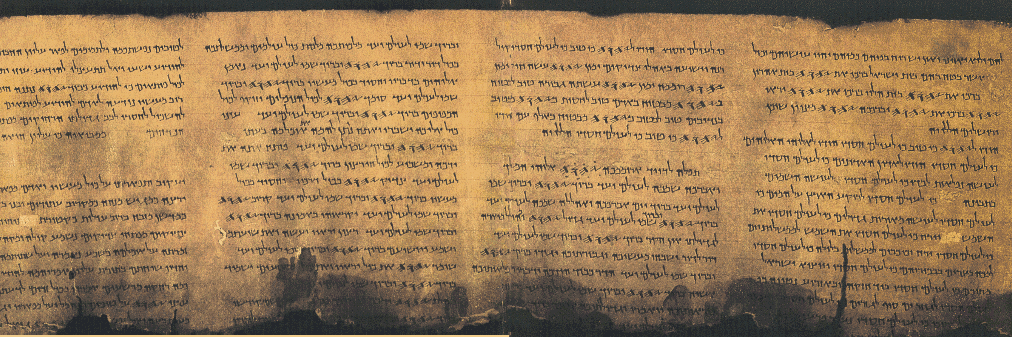
Parchment
Copied ca. 30 - 50 C.E.
Height 18.5 cm (7 1/4 in.), length 86 cm (33 3/4 in.)
Courtesy of the Israel Antiquities Authority
This impressive scroll is a collection of psalms and hymns, comprising parts of forty-one biblical psalms (chiefly form chapters 101-50), in non-canonical sequence and with variations in detail. It also presents previously unknown hymns, as well as a prose passage about the psalms composed by King David.
One of the longer texts to be found at Qumran, the manuscript was found in 1956 in Cave 11 and unrolled in 1961. Its surface is the thickest of any of the scrolls-Äit may be of calfskin rather than sheepskin, which was the more common writing material at Qumran. The script is on the grain side of the skin. The scroll contains twenty-eight incomplete columns of text, six of which are displayed here (cols. 14-19). Each of the preserved columns contains fourteen to seventeen lines; it is clear that six to seven lines are lacking at the bottom of each column.
The scroll's script is of fine quality, with the letters carefully drawn in the Jewish book-hand style of the Herodian period. The Tetragrammaton (the four-letter divine name), however, is written in the paleo-Hebrew script.
- Reference:
- Sanders, J. A. The Psalms Scroll of Qumran Cave 11 (11QPs
a). Discoveries in the Judaean Desert, IV. Oxford, 1965.
English Translation of the Psalms Scroll (Tehillim) 11QPs
Courtesy of the Israel Antiquities AuthorityColumn 19: Plea for Deliverance (A Noncanonical Psalm)
- Surely a maggot cannot praise thee nor a grave worm recount thy loving-kindness.
- But the living can praise thee, even those who stumble can laud thee. In revealing
- thy kindness to them and by thy righteousness thou dost enlighten them. For in thy hand is the soul of every
- living thing; the breath of all flesh hast thou given. Deal with us, O LORD,
- according to thy goodness, according to thy great mercy, and according to thy many righteous deeds. The LORD
- has heeded the voice of those who love his name and has not deprived them of his loving-kindness.
- Blessed be the LORD, who executes righteous deeds, crowning his saints
- with loving-kindness and mercy. My soul cries out to praise thy name, to sing high praises
- for thy loving deeds, to proclaim thy faithfulness--of praise of thee there is no end. Near death
- was I for my sins, and my iniquities have sold me to the grave; but thou didst save me,
- O LORD, according to thy great mercy, and according to thy many righteous deeds. Indeed have I
- loved thy name, and in thy protection have I found refuge. When I remember thy might my heart
- is brave, and upon thy mercies do I lean. Forgive my sin, O LORD,
- and purify me from my iniquity. Vouchsafe me a spirit of faith and knowledge, and let me not be dishonored
- in ruin. Let not Satan rule over me, n
Phylactery
Tefillin

Fragment A: height 17.7 cm (7 in.)
            length 3 cm (1 3/16 in.)
Fragment B: height 3.8 cm (1 1/2 in.)
            length 2.8 cm (1 1/8 in.)
Mur 4 Phyl
Parchment
Copied first century-early second century C.E.
Courtesy of the Israel Antiquities Authority (3)
The command "And thou shalt bind them for a sign upon thy hand, and they shall be for frontlets between thine eyes" (Deut. 6:8) was practiced by Jews from early times. In the Second Temple period the sages established that tefillin (phylacteries; amulets in Greek) would include four scriptural passages inscribed on parchment placed in box-like containers made of black leather. One of the phylacteries was worn one on the left arm and the other on the forehead. These served "as a sign upon your hand and as a symbol on your forehead that with a mighty hand the Lord freed us from Egypt" (Exodus 13:9, 16).The Dead Sea region has now yielded the earliest phylactery remains, both of the leather containers and the inscribed strips of parchment. As a rule, phylacteries include the same four selections, two from the book of Exodus (Exod. 13:1-10; 13:11-16) and two from Deuteronomy (Deut. 6:4-9; 11:13-21). The scriptural verses were penned in clear minuscule characters on the elongated writing material, which was folded over to fit the minute compartments stamped into the containers.
- References:
- Milik, J. T. "Textes Hebraux et Arameens." In Les Grottes de Murabba`at, Discoveries in the Judaean Desert, II, pp. 80- 85. Oxford, 1961.
Yadin, Y. "Tefillin (Phylacteries) from Qumran [XQ Phyl 1-4])" (in Hebrew), Eretz-Israel 9 (1969):60-83 and plates.
English Translation of the Phylactery (Tefillin) Scroll
Mur 4 Phyl
Courtesy of the Israel Antiquities Authority (3)
Exod. 13:1-3
- (1)And spoke
- the Lord to
- Moses
- saying, (2)"Consecrate
- to Me every first-born
- the first issue of every womb of the
- Israelites, man
- and beast is Mine."
- (3)And Moses said to the people,
- "Remember this day
- on which you went (free)
- from Egypt, the house of bondage,
- how with a mighty hand
- the Lord freed you from it; no
- leavened bread shall be eater. (4)This day
Community Rule
Serekh ha-Yahad
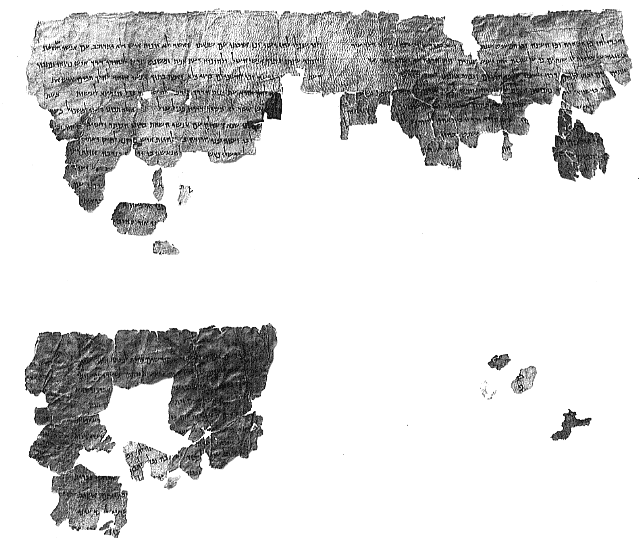
Height 8.8 cm (3 7/16 in.), length 21.5 cm (8 7/16 in.)
4Q258 (SOriginally known as The Manual of Discipline, the Community Rule contains a set of regulations ordering the life of the members of the "yahad," the group within the Judean Desert sect who chose to live communally and whose members accepted strict rules of conduct. This fragment cites the admonitions and punishments to be imposed on violators of the rules, the method of joining the group, the relations between the members, their way of life, and their beliefs. The sect divided humanity between the righteous and the wicked and asserted that human nature and everything that happens in the world are irrevocably predestined. The scroll ends with songs of praise to God.d) Parchment Copied late first century B.C.E.Äearly first century C.E. Courtesy of the Israel Antiquities Authority (7)
A complete copy of the scroll, eleven columns in length, was found in Cave 1. Ten fragmentary copies were recovered in Cave 4, and a small section was found in Cave 5. The large number of manuscript copies attests to the importance of this text for the sect. This particular fragment is the longest of the versions of this text found in Cave 4.
- Reference
- Qimron, E. "A Preliminary Publication of 4QS
d Columns VII-VIII" (in Hebrew). Tarbiz 60 (1991):435-37.
English Translation of The Community Rule
And according to his insight he shall admit him. In this way both his love and his hatred. No man shall argue or quarrel with the men of perdition. He shall keep his council in secrecy in the midst of the men of deceit and admonish with knowledge, truth and righteous commandment those of chosen conduct, each according to his spiritual quality and according to the norm of time. He shall guide them with knowledge and instruct them in the mysteries of wonder and truth in the midst of the members of the community, so that they shall behave decently with one another in all that has been revealed to them. That is the time for studying the Torah (lit. clearing the way) in the wilderness. He shall instruct them to do all that is required at that time, and to separate from all those who have not turned aside from all deceit.These are the norms of conduct for the Master in those times with respect to his loving and to his everlasting hating of the men of perdition in a spirit of secrecy. He shall leave to them property and wealth and earnings like a slave to his lord, (showing) humility before the one who rules over him. He shall be zealous concerning the Law and be prepared for the Day of Revenge.
He shall perform the will [of God] in all his deeds and in all strength as He has commanded. He shall freely delight in all that befalls him, and shall desire nothing except God's will...
Transcription and translation by E. Qimron.
Calendrical Document
Mishmarot

Height 13.4 cm (5 1/4 in.), length 21.1 cm (8 1/4 in.)
4Q321 (Mishmarot Ba)
Parchment
Copied ca. 50-25 B.C.E.
Courtesy of the Israel Antiquities Authority (10)
A significant feature of the community was its calendar, which was based on a solar system of 364 days, unlike the common Jewish lunar calendar, which consisted of 354 days. The calendar played a weighty role in the schism of the community from the rest of Judaism, as the festivals and fast days of the group were ordinary work days for the mainstream community and vice versa.
According to the calendar, the new year always began on a Wednesday, the day on which God created the heavenly bodies. The year consisted of fifty-two weeks, divided into four seasons of thirteen weeks each, and the festivals consistently fell on the same days of the week. It appears that these rosters were intended to provide the members of the "New Covenant" with a time-table for abstaining from important activities on the days before the dark phases of the moon's waning and eclipse (duqah).
- References
- Jaubert, A. "Le Calendrier de Jubiles et de la Secte de Qumran: Ses origines Bibliques," Vetus Testamentum 3 (1953):250-64.
- Talmon, S. "The Calendar of the Judean Covenanteers." In The World of Qumran from Within: Collected Studies, pp. 147-85. Jerusalem, 1989.
- Talmon, S. and I. Knohl. "A Calendrical Scroll from Qumran Cave IV -- Miþ Ba (4Q321)" (in Hebrew), Tarbiz 60 (1991):505-21.
English Translation of the Calendrical Document (Mishmarot)
- [on the first {day} in {the week of} Jedaiah {which falls} on the tw]elfth in it {the seventh month}. On the second {day} in {the week of} Abiah {which falls} on the twenty- f[ifth in the eighth {month}; and duqah {is} on the third] {day}
- [in {the week of} Miyamin {which falls} on the twelfth] in it {the eighth month}. On the third {day} in {the week of} Jaqim {which falls} on the twen[ty-fourth in the ninth {month}; and duqah {is} on the fourth] {day}
- [in {the week of} Shekania {which falls} on the eleven]th in it {the ninth month}. On the fifth {day} in {the week of} Immer {which falls} on the twe[n]ty-third in the te[nth {month}; and duqah {is} on the sixth {day} in {the week of} Je]shbeab {which falls}
- [on the tenth in] it {the tenth month}. On the [si]xth {day} in {the week of} Jehezkel {which falls} on the twenty-second in the eleventh month [and duqah {is on the} Sabbath in] {the week of} Petahah {which falls}
- [on the ninth in it {the eleventh month}]. On the first {day} in {the week of} Joiarib {which falls} on the t[w]enty-second in the twelfth month; and [duqah {is} on the seco]nd {day} in {the week of} Delaiah {which falls}
- [on the ninth in it {the twelfth month}. vacat The] se[cond] {year}: The first {month}. On the sec[on]d {day} in {the week of} Malakiah {which falls} on the tw[entieth in it {the first month}; and] duqah {is}
- [on the third {day} in {the week of} Harim {which falls} on the seventh] in it {the first month}. On the fou[r]th {day} in {the week of} Jeshua {which falls} [on] the twentieth in the second {month}; and [duqah {is} on the fifth {day} in {the week of]} Haqqos {which falls} on the seventh
- [in it {the second month}. On the fifth {day} in {the week of} Huppah {which falls} on the nine]teenth in the third {month}; and duqa[h] {is} on the six[th {day} in {the week of} Happisses {which falls}
Translation and transcription by S. Talmon and I. Knohl
Some Torah Precepts
Miqsat Ma`ase ha-Torah
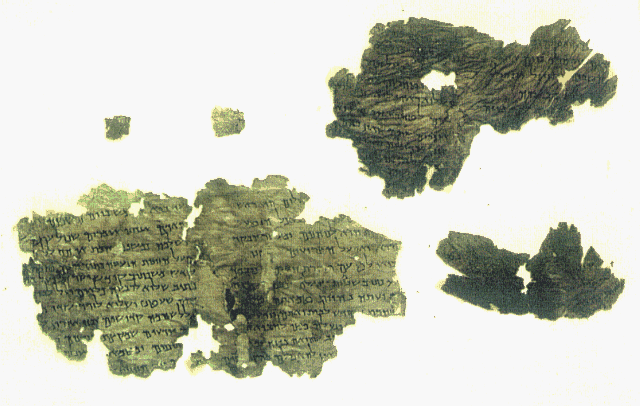
Fragment A: height 8 cm (3 1/8 in.)
            length 12.9 cm (5 in.)
Fragment B: height 4.3 cm (1 11/16 in.)
            length 7 cm (2 3/4 in.)
Fragment C: height 9.1 cm (3 9/16 in.)
            length 17.4 cm (6 7/8in.)
4Q396(MMT
Apparently it consisted of four sections: (1) the opening formula, now lost; (2) a calendar of 364 days; (3) a list of more than twenty rulings in religious law (Halakhot), most of which are peculiar to the sect; and (4) an epilogue that deals with the separation of the sect from the multitude of the people and attempts to persuade the addressee to adopt the sect's legal views. The "halakhot," or religious laws, form the core of the letter; the remainder of the text is merely the framework. The calendar, although a separate section, was probably also related to the sphere of "halakhah." These "halakhot" deal chiefly with the Temple and its ritual. The author states that disagreement on these matters caused the sect to secede from Israel.
- References
- Strugnell, J., and E. Qimron. Discoveries in the Judaean Desert, X. Oxford, forthcoming.
- Sussman, Y. "The History of 'Halakha' and the Dead Sea Scrolls -- Preliminary Observations on Miqsat Ma`ase Ha-Torah (4QMMT)" (in Hebrew), Tarbiz 59 (1990):11-76.
English Translation of Some Torah Precepts (Miqsat Ma'ase ha-Torah)
4Q396(MMTc)
Courtesy of the Israel Antiquities Authority (8)
- until sunset on the eighth day. And concerning [the impurity] of
- the [dead] person we are of the opinion that every bone, whether it
- has its flesh on it or not--should be (treated) according to the law of the dead or the slain.
- And concerning the mixed marriages that are being performed among the people, and they are sons of holy [seed],
- as is written, Israel is holy. And concerning his (Israel's) [clean] animal
- it is written that one must not let it mate with another species, and concerning his clothes [it is written that they should not]
- be of mixed stuff; and one must not sow his field and vineyard with mixed species.
- Because they (Israel) are holy, and the sons of Aaron are [most holy.]
- But you know that some of the priests and [the laity intermingle]
- [And they] adhere to each other and pollute the holy seed
- as well as their (i.e. the priests') own [seed] with corrupt women. Since [the sons of Aaron should...]
Enoch
Hanokh
Fragment A height 17.5 cm (6 7/8 in.), length 17.5 cm (6 7/8 in.)
Fragment B height 6.4 cm (2 1/2 in.), length 6.9 cm (2 11/16 in.)
4Q201 (En arOne of the most important apocryphic works of the Second Temple Period is Enoch. According to the biblical narrative (Genesis 5:21-24), Enoch lived only 365 years (far less than the other patriarchs in the period before the Flood). Enoch "walked with God; then he was no more for God took him."a) Parchment Copied ca. 200-150 B.C.E. Courtesy of the Israel Antiquities Authority (11) The original language of most of this work was, in all likelihood, Aramaic (an early Semitic language). Although the original version was lost in antiquity, portions of a Greek translation were discovered in Egypt and quotations were known from the Church Fathers. The discovery of the texts from Qumran Cave 4 has finally provided parts of the Aramaic original. In the fragment exhibited here, humankind is called on to observe how unchanging nature follows God's will.
The Book of Enoch is a pseudepigraphal work (a work that claims to be by a biblical character). The Book of Enoch was not included in either the Hebrew or most Christian biblical canons, but could have been considered a sacred text by the sectarians. The original Aramaic version was lost until the Dead Sea fragments were discovered.
- Reference
- Milik, Jazef. T., ed. The Books of Enoch: Aramaic Fragments of Qumran Cave 4 (Oxford, 1976) Printed book. General Collections, Library of Congress.
English Translation of Enoch (Hanokh)
4Q201 (En ara) Courtesy of the Israel Antiquities Authority (11) EnTranscription by J. T. Milik, amended by J. C. Greenfield; translation by J. C. Greenfielda I ii 12. ...But you have changed your works, 13. [and have not done according to his command, and tran]sgressed against him; (and have spoken) haughty and harsh words, with your impure mouths, 14. [against his majesty, for your heart is hard]. You will have no peace. Ena I iii 13. [They (the leaders) and all ... of them took for themselves] 14. wives from all that they chose and [they began to cohabit with them and to defile themselves with them]; 15. and to teach them sorcery and [spells and the cutting of roots; and to acquaint them with herbs.] 16. And they become pregnant by them and bo[re (great) giants three thousand cubits high ...]
Hosea Commentary
Pesher Hoshe`a
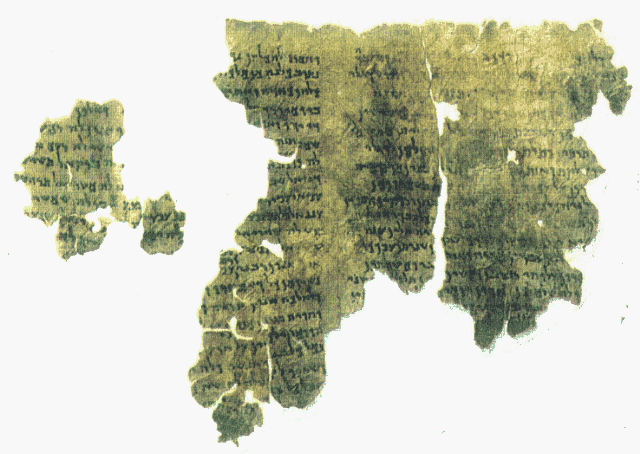
a) Parchment Copied late first century B.C.E. Height 17.5 cm (6 7/8 in.), length 16.8 cm (6 5/8 in.) Courtesy of the Israel Antiquities Authority (6) The manuscript shown here is the larger of two unrelated fragments of the Hosea Commentary found in Cave 4. The script, which is identical to that of a commentary on Psalms, belongs to the rustic, semiformal type of the Herodian era.
The Hosea Commentary Scroll was first published by J. Allegro as the fifth volume of the official publication series, "Discoveries in the Judaean Desert."
In 1979, M. Horgan completed a work on all the "pesharim," or commentaries, which included an extensive treatment of the Hosea Commentary fragments. The "pesharim" interpreted the biblical text in light of events of the late Second Temple Period--seeing within the text prophesies and messages relevant to the community's beliefs and practices.
- References
- John Marco Allegro Qumran Cave 4. DJD V (Oxford, 1968) Printed book. General Collections, Library of Congress
- Maurya Horgan Pesharim: Qumran Interpretations of Biblical Books (Washington, D.C., 1979) Printed book. General Collections, Library of Congress
English Translation of Hosea Commentary (Pesher Hoshe`a)
4Q166 (4QpHosHos. 2:10-14a) Courtesy of the Israel Antiquities Authority (6) Transcription and translation by M. Horgan
- (10)[SHE DID NOT KNOW THAT] I MYSELF HAD GIVEN HER THE GRAIN [AND THE WINE]
- [AND THE OIL, AND] (THAT) I HAD SUPPLIED [SILVER] AND GOLD ... (WHICH) THEY MADE [INTO BAAL. The interpretation of it is]
- that [they] ate [and] were satisfied, and they forgot God who [had fed them, and all]
- his commandments they cast behind them, which he had sent to them [by]
- his servants the prophets. But to those who led them astray they listened, and they honored them [ ]
- and as if they were gods, they fear them in their blindness.
- vacat
- (11)THEREFORE, I SHALL TAKE BACK MY GRAIN AGAIN IN ITS TIME AND MY WINE [IN ITS SEASON,]
- AND I SHALL WITHDRAW MY WOOL AND MY FLAX FROM COVERING [HER NAKEDNESS.]
- (12)I SHALL NOW UNCOVER HER PRIVATE PARTS IN THE SIGHT OF [HER] LO[VERS AND]
- NO [ONE] WILL WITHDRAW HER FROM MY HAND.
- The interpretation of it is that he smote them with famine and with nakedness so that they became a disgra[ce]
- and a reproach in the sight of the nations on whom they had leaned for support, but they
- will not save them from their afflictions. (13)AND I SHALL PUT AN END TO ALL HER JOY,
- [HER] PIL[GRIMAGE,] HER [NEW] MOON, AND HER SABBATH, AND ALL HER FEASTS. The interpretation of it is that
- they make [the fe]asts go according to the appointed times of the nation. And [all]
- [joy] has been turned for them into mourning. (14)AND I SHALL MAKE DESOLATE [HER VINE]
- [AND HER FIG TREE,] OF WHICH SHE SAID, "THEY ARE THE HIRE [THAT MY LOVERS HAVE GIVEN] ME."
- AND I SHALL MAKE THEM A FOREST, AND THE W[ILD BEAST OF THE FIELD] WILL DEVOUR THEM.
Prayer For King Jonathan
Tefillah li-Shlomo shel Yonatan ha-Melekh
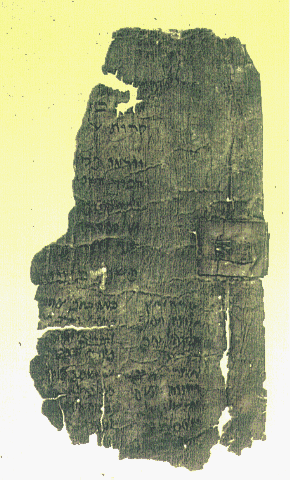
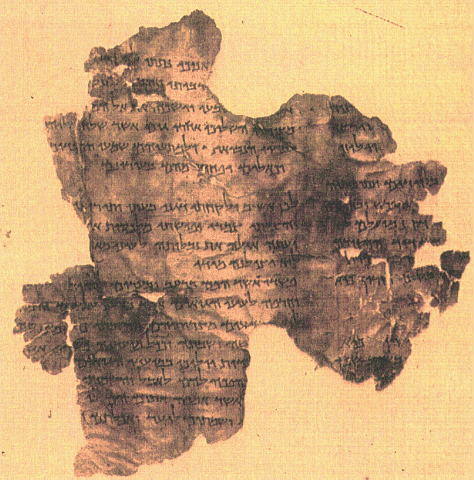
The King Jonathan mentioned in this text can be none other than Alexander Jannaeus, a monarch of the Hasmonean dynasty who ruled Judea from 103 to 76 B.C.E. The discovery of a prayer for the welfare of a Hasmonean king among the Qumran texts is unexpected because the community may have vehemently opposed the Hasmoneans. They even may have settled in the remote desert to avoid contact with the Hasmonean authorities and priesthood. If this is indeed a composition that clashes with Qumran views, it is a single occurrence among 600 non-biblical manuscripts. However, scholars are exploring the possibility that Jonathan-Jannaeus, unlike the other Hasmonean rulers, was favored by the Dead Sea community, at least during certain periods, and may explain the prayer's inclusion in the Dead Sea materials.4Q448 Parchment Copied between 103-76 B.C.E. Height 17.8 cm (7 in.), length 9.5 cm (3 3/4 in.) Courtesy of the Israel Antiquities Authority (2)
This text is unique in that it can be clearly dated to the rule of King Jonathan. Three columns of script are preserved, one on the top and two below. The upper column (A) and the lower left (C) column are incomplete. The leather is torn along the lower third of the right margin. A tab of untanned leather, 2.9 by 2.9 cm, folds over the right edge above the tear. A leather thong, remains of which were found threaded through the middle of the leather tab on the right edge, probably tied the rolled-up scroll. The form of the tab--probably part of a fastening--seems to indicate that the extant text was at the beginning of the scroll, which was originally longer. Differences between the script of Column A and that of B and C could indicate that this manuscript is not the work of a single scribe.
This small manuscript contains two distinct parts. The first, column A, presents fragments of a psalm of praise to God. The second, columns B and C, bear a prayer for the welfare of King Jonathan and his kingdom. In column A lines 8-10 are similar to a verse in Psalm 154, preserved in the Psalms Scroll (11QPsa) exhibited here. This hymn, which was not included in the biblical Book of Psalms, is familiar, however, from the tenth-century Syriac Psalter.
- Reference:
- Eshel, E., H. Eshel, and A. Yardeni. "A Qumran Scroll Containing Part of Psalm 154 and a Prayer for the Welfare of King Jonathan and His Kingdom," Israel Exploration Journal, forthcoming.
English Translation of Prayer For King Jonathan (Tefillah li-Shlomo shel Yonatan ha-Melekh)
4Q448
Courtesy of the Israel Antiquities Authority (2)

    Column A

1.  Praise the Lord, a Psalm [of
2.  You loved as a fa[ther(?)
3.  you ruled over [
4.  vacat [
5.  and your foes were afraid (or: will fear) [
6.  ...the heaven [
7.  and to the depths of the sea [
8.  and upon those who glorify him [
9.  the humble from the hand of adversaries [
10. Zion for his habitation, ch[ooses

    Column C                             Column B
1.  because you love Isr[ael         1.  holy city
2.  in the day and until evening [   2.  for king Jonathan
3.  to approach, to be [             3.  and all the
                                         congregation
                                         of your people
4.  Remember them for blessing [     4.  Israel
5.  on your name, which is called [  5.  who are in the four
6.  kingdom to be blessed [          6.  winds of heaven
7.  ]for the day of war [            7.  peace be (for) all
8.  to King Jonathan [               8.  and upon your kingdom
9.                                   9.  your name be blessed
Transcription and translation by E. Eshel, H. Eshel, and A. Yardeni
Leviticus
Va-Yikrah

This scroll was discovered in 1956, when a group of Ta`amireh Bedouin happened on Cave 11, but it was first unrolled fourteen years later, at the Israel Museum in Jerusalem. Inscribed in the scroll are parts of the final chapters (22-27) of Leviticus, the third book in the Pentateuch, which expounds laws of sacrifice, atonement, and holiness. This is the lowermost portion (approximately one-fifth of the original height) of the final six columns of the original manuscript. Eighteen small fragments also belong to this scroll. The additional fragments of this manuscript are from preceding chapters: Lev. 4, 10, 11, 13, 14, 16, 18-22.11Q1(PaleoLev) Parchment Copied late second century - early first century B.C.E. Height 10.9 cm (4 1/4 in.), length 100.2 cm (39 1/2 in.) Courtesy of the Israel Antiquities Authority (4)
The Leviticus Scroll was written in an ancient Hebrew script often referred to as paleo-Hebrew. The almost uniform direction of the downstrokes, sloping to the left, indicates an experienced, rapid, and rhythmic hand of a single scribe. The text was penned on the grain side of a sheep skin. Both vertical and horizontal lines were drawn. The vertical lines aligned the columns and margins; the horizontal lines served as guidelines from which the scribe suspended his letters. Dots served as word-spacers.
Reference:
Freedman, D. N., and K. A. Mathews. The Paleo-Hebrew Leviticus Scroll. Winona Lake, Indiana, 1985.
English Translation of Leviticus (Va-Yikrah)
11Q1(PaleoLev)
Courtesy of the Israel Antiquities Authority (4)
Lev. 23:22-29
- (22)[...edges of your field, or] gather [the gleanings of your harvest; you shall leave them for the poor and the stranger; I the LO]RD [am]
- your God.
- (23)The LORD spoke to Moses saying: (24)Speak to the Israelite people thus: In the seventh month
- on the first day of the month, you shall observe complete rest, a sacred occasion commemorated with load blasts.
- (25)You shall not work at your occupations; and you shall bring an offering by fire to the LORD.
- (26)The LORD spoke to Moses saying: (27)Mark, the tenth day of this seventh month is the Day
- of Atonement. It shall be a sacred occasion for you: you shall practice self-denial, and you shall bring an offering
- by fire to the LORD; (28)you shall do no work throughout that day. For
- [it is a Day of Atonement on which] expiation is made on your behalf [before the LO]RD your God. (29)Indeed, any person who
Translation from "Tanakh," p. 192. Philadelphia, 1985.
Songs of the Sabbath Sacrifice
Shirot `Olat ha-Shabbat
4Q403(ShirShabbd)
Parchment
Copied mid-first century B.C.E.
Height 18 cm (7 in.), length 19 cm (7 1/2 in.)
Courtesy of the Israel Antiquities Authority (9)
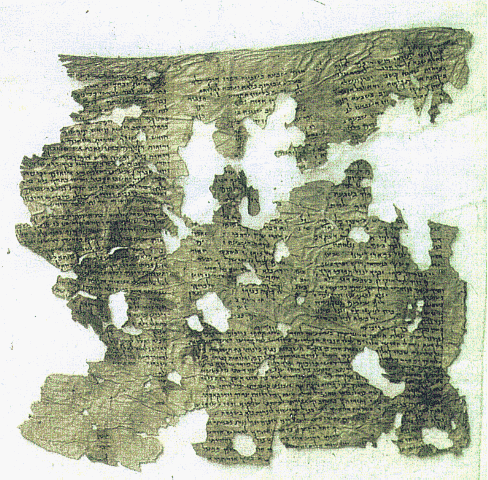
The Songs of the Sabbath Sacrifice, also known as the "Angelic Liturgy," is a liturgical work composed of thirteen separate sections, one for each of the first thirteen Sabbaths of the year. The songs evoke angelic praise and elaborate on angelic priesthood, the heavenly temple, and the Sabbath worship in that temple.
The headings of the various songs may reflect the solar calendar. Although the songs bear no explicit indication of their source, the phraseology and terminology of the texts are very similar to those of other Qumran works.
Eight manuscripts of this work were found in Qumran Cave 4 (4Q400 through 407) and one in Cave 11, dating from the late Hasmonean and Herodian periods. One manuscript of the Songs of the Sabbath Sacrifice was found at Masada, a Zealot fortress.
- References:
- Newsom, Carol. Songs of the Sabbath Sacrifice: A Critical Edition. Atlanta, 1985. This is the definitive translation and analysis of these distinctive hymns.
- Strugnell, J. "The Angelic Liturgy at Qumran--4QSerek Sirot `Olat Hassabbat." In Congress Volume, Oxford 1959. Supplements to Vetus Testamentum, vol. 7, pp. 318-45. Leiden, 1960.
English Translation of Songs of the Sabbath Sacrifice (Shirot `Olat ha-Shabbat)
4Q403(ShirShabbd)
Courtesy of the Israel Antiquities Authority (9)

30.  By the instructor.  Song of the sacrifice of the seventh
     Sabbath on the sixteenth of the month. Praise the God of
     the lofty heights, O you lofty ones among all the

31.  elim of knowledge. Let the holiest of the godlike ones
     sanctify the King of glory who sanctifies by holiness
     all His holy ones. O you chiefs of the praises of

32.  all the godlike beings, praise the splendidly
     [pr]aiseworthy God. For in the splendor of praise
     is the glory of His realm. From it (comes) the praises
     of all

33.  the godlike ones together with the splendor of all [His]
     maj[esty. And] exalt his exaltedness to exalted heaven,
     you most godlike ones of the lofty elim,
     and (exalt) His  glorious divinity above

34.  all the lofty heights. For H[e is God of gods] of all
     the chiefs of the heights of heaven and King
     of ki[ngs] of all the eternal councils.
     (by the intention of)

35.  (His knowledge) At the words of His mouth come into
     being [all the lofty angels]; at the utterance
     of His lips all the eternal spirits; [by the in]tention
     of His knowledge all His creatures

36.  in their undertakings. Sing with joy, you who rejoice
     [in His knowledge with] rejoicing among the wondrous
     godlike beings. And chant His glory with the
     tongue of all who chant with knowledge;
     and (chant) His wonderful songs of joy

37.  with the mouth of all who chant [of Him. For He is]
     God of all who rejoice {in knowledge}
     forever and Judge in His  power of all the
     spirits of understanding.
Transcription and translation by C. Newsom
Damascus Document
Brit Damesek
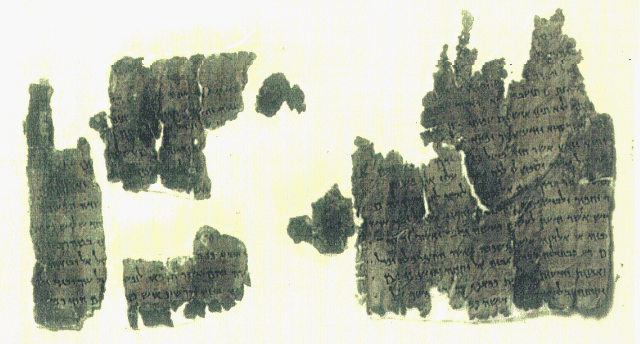
The Damascus Document is a collection of rules and instructions reflecting the practices of a sectarian community. It includes two elements. The first is an admonition that implores the congregation to remain faithful to the covenant of those who retreated from Judea to the "Land of Damascus." The second lists statutes dealing with vows and oaths, the tribunal, witnesses and judges, purification of water, Sabbath laws, and ritual cleanliness. The right-hand margin is incomplete. The left-hand margin was sewn to another piece of parchment, as evidenced by the remaining stitches.4Q271(Df) Parchment Copied late first century B.C.E. Height 10.9 cm (4 1/4 in.), length 9.3 cm (3 5/8 in.) Courtesy of the Israel Antiquities Authority (1)
In 1896, noted Talmud scholar and educator Solomon Schechter discovered sectarian compositions which later were found to be medieval versions of the Damascus Document. Schechter's find in a synagogue storeroom near Cairo, almost fifty years before the Qumran discoveries, may be regarded as the true starting point of modern scroll research.
- References:
- Baumgarten, J. "The Laws of the Damascus Document in Current Research." In The Damascus Document Reconsidered. Edited by M. Broshi. Jerusalem, 1992. Written by Baltimore Hebrew University scholar Joseph Baumgarten, this 1992 imprint includes an analysis of the Damascus Document and its relation to Jewish Law, or halakhah.
- Rabin, C. The Zadokite Documents. Oxford, 1958.
- Schechter, S. Fragments of a Zadokite Work: Documents of Jewish Sectaries, vol. 1. Cambridge, England, 1910.
English Translation of Damascus Document (Brit Damesek)
4Q271(Df)
Courtesy of the Israel Antiquities Authority (1)
- ...with money...
- ...[his means did not] suffice to [return it to him] and the year [for redemption approaches?]...
- ...and may God release him? from his sins. Let not [ ] in one, for
- it is an abomination....And concerning what he said (Lev. 25:14), ["When you sell
- anything to or buy anything from] your neighbor, you shall not defraud one another," this is the expli[cation...
- ...] everything that he knows that is found...
- ...and he knows that he is wronging him, whether it concerns man or beast. And if
- [a man gives his daughter to another ma]n, let him disclose all her blemishes to him, lest he bring upon himself the judgement
- [of the curse which is said (Deut. 27:18)] (of the one) that "makes the blind to wander out of the way." Moreover, he should not give her to one unfit for her, for
- [that is Kila'yim, (plowing with) o]x and ass and wearing wool and linen together. Let no man bring
- [a woman into the holy] who has had sexual experience, whether she had such experience
- [in the home] of her father or as a widow who had intercourse after she was widowed. And any woman
- [upon whom] there is a bad name in her maidenhood in her father's home, let no man take her, except
- [upon examination] by reliable [women] who have clear knowledge, by command of the Supervisor over
- [the Many. After]ward he may take her, and when he takes her he shall act in accordance with the law ...and he shall not tell...
- [ ] L [ ]
Transcription and translation by J. Baumgarten
The War Rule
Serekh ha-Milhamah

4Q285 (SM)
Parchment
Copied early first century C.E.
Height 4 cm (1 1/2 in.), length 5 cm (2 in.)
Courtesy of the Israel Antiquities Authority (12)
This six-line fragment, commonly referred to as the "Pierced Messiah" text, is written in a Herodian script of the first half of the first century C.E. and refers to a Messiah from the Branch of David, to a judgement, and to a killing.
Hebrew is comprised primarily of consonants; vowels must be supplied by the reader. The appropriate vowels depend on the context. Thus, the text (line 4) may be translated as "and the Prince of the Congregation, the Branch of David, will kill him," or alternately read as "and they killed the Prince." Because of the second reading, the text was dubbed the "Pierced Messiah." The transcription and translation presented here support the "killing Messiah" interpretation, alluding to a triumphant Messiah (Isaiah 11:4).
In September 1992, "Time Magazine" published an article on the War Rule fragment displayed here (object no. 12) exploring the differing interpretations. A "piercing messiah" reading would support the traditional Jewish view of a triumphant messiah. If, on the other hand, the fragment were interpreted as speaking of a "pierced messiah," it would anticipate the New Testament view of the preordained death of the messiah. The scholarly basis for these differing interpretations--but not their theological ramifications--are reviewed in "A Pierced or Piercing Messiah?"
- References
- Vermes, G. "The Oxford Forum for Qumran Research: Seminar on the Rule of the War from Cave 4 (4Q285)," Journal of Jewish Studies 43 (Spring 1992):85-90.
- Richard N. Ostling Is Jesus in the Dead Sea Scrolls? Time (September 21, 1992) Unbound serial. Hebraic Section, African and Middle Eastern Division, Library of Congress.
- James D. Tabor A Pierced or Piercing Messiah? -- The Verdict is Still Out Biblical Archaeology Review 18 (November - December 1992) Unbound serial. Hebraic Section, African and Middle Eastern Division, Library of Congress.
English Translation of The War Rule (Serekh ha-Milhamah)
4Q285 (SM)
Courtesy of the Israel Antiquities Authority (12)
- ]Isaiah the prophet: [The thickets of the forest] will be cut [down
- with an axe and Lebanon by a majestic one will f]all. And there shall come forth a shoot from the stump of Jesse [
- ] the Branch of David and they will enter into judgement with [
- ] and the Prince of the Congregation, the Bran[ch of David] will kill him [
- by stroke]s and by wounds. And a Priest [of renown (?)] will command [
- the s]lai[n] of the Kitti[m]

